
Lectures analytiques de quelques concepts normatifs dans Beowulf
Propos introductifs de Jérôme Devard
Blood and Deeds : The Inheritance Systems in Beowulf de Michael D. C. Drout
The forbidden Beowulf : haunted by incest de James W. Earl
Reading Beowulf with Isidore's Etymologies de Roberta Frank
Hospitality, hostility, and peacemaking in Beowulf de Fabienne L. Michelet
Royal power and royal symbols in Beowulf de Barbara Raw
BLOOD AND DEEDS : THE INHERITANCE SYSTEMS IN BEOWULF*
Michael D. C. Drout
Beowulf begins with successful inheritances. Arriving in Denmark from across the sea, Scyld Scefing builds up the Danish kingdom and bequeaths it to his son and "eafera" (v. 12a) [heir], Beowulf Scyldinga(1). This Beowulf works to build up his father's kingdom, and when Scyld dies the power and wealth of his people are so great that the Scyldings are able to provide their old king with a glorious ship funeral that ends his reign and inaugurates that of his son :
Ðawæs on burgum Beowulf Scyldinga
leof leodcyning longe þrage
folcum gefræge fæder ellor hwearf
aldor of earde oþ þat him eft onwoc
heah Healfdene heold þenden lifde
gamol ond guðreouw glæde Scyldingas.
Ðæm feower bearn forðgerime
in world wocun weoroda ræawal[n]
Heorogar ond Hroðgar ond Halga til
hyrde ic þaet [………..wæs On]elan cwen. (Beowulf, v. 53-62)
[Then was in the castle, Beowulf of the Scyldings, the beloved king of the people, ruling a long time, known to the folk - his father turned elsewhere, the lord from the land-until to him afterwards was born great Healfdane. He ruled the glad Scyldings as long as he lived, old and battle-fierce. To him four children were born in succession into the world : Heorogar and Hrothgar and Halga the Good; I have heard that the fourth child was Onela's queen.]
In this passage, kingly power and identity pass smoothly from Scyld to Beowulf Scyldinga to Healfdane. Although we are not specifically told that Beowulf and Healfdane are both the only sons of their respective fathers, we have no reason to assume otherwise - there are no additional brothers in Beowulf or in the various possible Scandinavian analogues(2). At each step of the genealogical progression, the father reproduces himself only once, in the person of his son and worthy successor. But then Healfdane has four children : Heorogar, Hrothgar, Halga, and a daughter whose name has been lost(3). The straightforward progression from father to son is complicated. Heorogar, Healfdane's oldest son, rules briefly but dies (466b-68), leaving Hrothgar, the second brother, to be king (v. 64-67b).
Hrothgar's assumption of the throne in the place of his brother illustrates a problem with the processes of inheritance and succession that tothis point in the poem has been obscured by the easy passage of power from one father to one son. Beowulf Scyldinga and Healfdane are the optimal inheritors of their respective fathers because each is his father's only heir. But Heorogar should have succeeded Healfdane not only because he was the elder son but also because he would have been a superior king - or so says Hrothgar : "Se wæs betera ðonne ic" (469b) [he was a better man than I](4). Hrothgar, the eventual inheritor, states that he is not the optimal ruler, although he is hardly a bad king until Grendel's depredations show him to have become weak in his old age : "þæt wæs an cyning / æghwæsorlea htre, oþ þæt hine yldo benam / mægenes wynnum" (v.1885-87) [that was a singularly good king, blameless in all, until his age took from him the joys of power]. But although Hrothgar has proven to be a worthy inheritor of his line,his own sons do not get the chance to inherit from him. At the time of Grendel's death, Hrothgar is an old king, but his sons Hrethric and Hrothmund are still seated among the "giogoð" (v. 1189-1190b) [youths], where Beowulf, presumably because he is a visitor, is placed at the feast. It seems that neither son will be strong or old enough to assume the mantle of kingship when Hrothgar dies. Wealhtheow the queen suggests just this possibility when she proposes that Hrothulf, Hrothgar's nephew, will protect the young boys if Hrothgar dies before Hrethric (presumably the older of the two sons) is able to become king (v. 1180-1187). Hrothgar's sons, while heirs of the king's body, are not fit to assume the throne-apparently the warrior troop recognized that they cannot do those things that are necessary for kings to do. Blood is not enough.
Beowulf, on the other hand, while not a blood heir of Hrothgar, is equal to the demands of leadership, or so the old king believes. In another controversial scene, Hrothgar appears to "adopt" Beowulf as his son. After Beowulf has killed Grendel, Hrothgar addresses the hero : "nuic, Beowulf, þec, / secg betsta, me to sunu wylle / freogan on ferhþe ; heald forð tela / sibbe" (v. 946b-9449a) [now I wish you, Beowulf, the best of warriors, to be as a son to me, to love in spirit; to hold forth properly this new kinship]. Although critics have been divided as to whether or not Hrothgar's gesture is a true adoption into the lineage or merely a spiritual and social embrace, Wealhtheow, at least, seems to recognize Hrothgar's action as possessing dynastic implications. After the scop has sung the tale of Finn and Hengest, Wealhtheow offers a cup to Hrothgar and says,
Me man sægde, þaet þu ðe for sunu wolde
hereri[n]c habban. Heorot is gefælsod,
beahsele beorhta ; bruc þenden þu mote
manigra medo, ond þinum magum læf
folc ond rice, þonne ðu forð scyle,
metodsceaft seon. (Beowulf, v. 1175-118oa)
[Men tell me that you wish to have this battle-warrior for a son. Heorot is cleansed, the bright ring-hall. Enjoy, while you are able to be permitted, its many rewards, and leave to your kin the people and the kingdom when you shall go forth to the decree of fate.]
Wealhtheow sees the adoption of Beowulf as an action that could damage her sons' chances of succession, and she does not believe that Hrothgar's offer of synthetic kinship is at all appropriate. She therefore, according to John Hill's analysis, attempts to remind Hrothgar that he has duties to his kin and that the victory feast is not the time or place for the determination of a successor (v. 101-102)(5). In place of Hrothgar's adoption of the unrelated Beowulf, she offers a man of closer kinship, Hrothulf, Hrothgar's nephew, as protector for the sons(6).
The potential conflict over succession to the Danish throne after Hrothgar's death makes apparent dynamics of inheritance that are otherwise obscured by the smooth passage of power and identity from Scyld to Beowulf Scyldinga to Healfdane. The difficulties with the succession of Hrethric or Hrothmund and the solutions proposed in the poem show that what seems to be a seamless process of inheritance in fact operates along two tracks. Inheritance by blood is a familiar idea ; under this system, power and identity passes along the line of genetic descent, from father to son. Inheritance by deeds is a more nebulous concept but is epitomized by Hrothgar's attempt to nominate Beowulf as successor : the hero's deeds, rather than his lineage, allow him to be identified as a potential heir.
In ideal situations, the two systems are complementary and isomorphic, so the two separate processes appear to be one. Beowulf Scyldinga is not only his father's only son but also a worthy warrior and king who "earns" his title through his conquests and his contributions to the welfare of the Danish folk ; Healfdane is likewise legitimate in both categories. Hrothgar, too, is a king by deeds as well as by blood, although it is possible that his replacement of his brother (the eldest son) in the kingship is meant to explain his failure to prepare the ground for the successful continuation of the Danish dynasty. That is, Hrothgar, while legitimately king in every sense, is not the best possible king by blood (or, as we learn after Grendel's attacks, by deeds). The apparent failure of Hrothgar's sons to succeed him illustrates that not all successions are ideal. Not all heirs are optimal in both systems.
In fact, less-than-ideal successions are more the norm than the exception in Beowulf. Most inheritors are legitimated to different degrees in each category, some more by blood, some more by deeds, and the cultural politics of blood are not always the cultural politics of deeds. Both systems are necessary for inheritance, and both reinforce each other in the ideal cases of Beowulf Scyldinga and Healfdane, but in many other cases inheritance by blood competes with inheritance by deeds.
Like any competing social process, each form of inheritance differentially rewards individuals. Different people, therefore, have different stakes in the two systems. Some may benefit more from a greater emphasis on blood ; others might gain more under a more deeds-focused system. Although every individual would likely seek a different balance of blood - and deeds-based inheritance in order to maximize his or her own circumstances, there are also some general tendencies that can be attributed to members of different social groups. Inheritance by blood is the province of the kin group ; inheritance by deeds is most prominent in the warrior band (individual membership in these institutions, does, of course, overlap). Blood inheritance happens through the direct agency of women via biological reproduction. Inheritance by deeds is constructed (in Beowulf) as a solely masculine activity. Thus, the inheritance system in Beowulf is broadly gender-asymmetric, with implications for the relationships of women with their husbands, sons, and nephews, and for gender politics in general.
By analyzing the two inheritance systems, we may make new sense of some of the more enigmatic moments in Beowulf. Comparing the operations of inheritance in Beowulf to the processes of inheritance in thewider Anglo-Saxon culture and examining who has a greater stake in which systems in what contexts can provide a better understanding of both the cultural world in Beowulf and the culture that valued the poem enough to copy it (at the very least) and thus preserve it(7).
BLOOD AND KINSHIP
In the simplest form of inheritance by blood, children receive the names and possessions of their parents. Social offices, rights, or titles are still passed on to children selected simply by means of birth. But blood inheritance in the Anglo-Saxon age was different from familiar processes of blood inheritance in contemporary cultures(8).These differences are caused by the employment of different sets of rules for determining blood relations. The well-known problems of the date and provenance of Beowulf and the fact that the poem is a literary work and not a historical document prevent us from assuming that the kinship system in Beowulf is identical to that in Anglo-Saxon England, but it seems reasonable to infer broad parallels between Beowulf and Anglo-Saxon culture, particularly because nothing in the poem contradicts those kinship terminology and inheritance relations that are historically documented.
The kinship system in historical Anglo-Saxon England was "non- unilineal" ; individuals could trace their lineage through both parents and their descendants. Thus, any given individual had a slightly different set of kinship relations. Because Old English lacks specific terms that would distinguish between cousins of various degrees, Lorraine Lancaster has concluded that "these kin and the distinctions between them [were] not regularly of major significance."(9) Direct lineal relations, however, were significant ; lineal ascendants could be traced back to the sixta fæder (sixth forefather, i.e., great-great-great-great-great-grandfather). Collateral kin were also recognized. An individual's father's brother was fædera ; the mother's brother was eam. Brother's sons are referred to as suhterga and geswiria, while a sister's son is, logically, a swustorsunu. Nefa and genefa are more general terms having the modern equivalence of "nephew," while nift and nefena can be translated as "niece." As the above terminology shows, major distinctions are made between "kin of the same genealogical position but different sex."(10).
As Lancaster notes, the Kentish laws of Hlothhere and Eadric imply "that the child should regularly receive property from his father"(11). Other Anglo-Saxon laws, including those of Alfred, limit inheritance to a given kin-range, mæburge, but do not give preference to certain heirs. The laws of Cnut also suggest that a man who had fulfilled his obligations during his lifetime could leave his estate to "whomever he pleased after his death." In general, then, and throughout the Anglo-Saxon period, it appears that "wife, children and close kin were expected to be the chief heirs of a man's property, but that considerable freedom in disposal existed"(12).
The inheritance of political power and social position was likewise a rather flexible process, although there were obviously some constraints. The various royal genealogies seem to show a number of unbroken paths of descent, but these genealogies and pedigrees were used to legitimate the power of rulers and bind together disparate kin-groups. Genealogies, David Dumville argues, are constructed "retrospectively". Rather than reflecting biological fact, they indicate political circumstances and necessities at the time of their production(13). Thus, the man chosen to rule an Anglo-Saxon kingdom "from c. 850 to c. 975 appears to have been the most credible candidate for power and responsibility among the eligible members of the royal house"(14).
Although the actual practice of kingly succession may have been some what more messy than a simple father-to-son passage of power, the Anglo-Saxon ideal seems to be that of straightforward patrilineal inheritance from a father to one son (the process depicted in the inheritances of Beowulf Scyldinga from Scyld and Healfdane from BeowulfScyldinga). The genealogical passages in Bede and William of Malmesbury identify ancestors as (son of) or cuius pater (who is the father of)(15). In documents written in Old English (for example, the version of The Anglo-Saxon Chronicle in London, British Library MS Cotton Tiberius B. IV a surname is constructed by adding the suffix -ing to a father's name. Thus, we see Beaw Scealding as the father of Tætwa Beawing who is the father of Geat Tætwæing(16). Craig R. Davis argues that "succession was governed by a system of aetheling competition in which any son or grandson of the king could become a candidate for the throne"(17).
Succession in Beowulf operates no more predictably than it did in historical Anglo-Saxon society. Fathers do not always pass title and power to their sons. Yet the ideal of patrilineal genealogy is present in the culture created within the poem and, scholars have argued, in a culture that valued Beowulf(18). The West-Saxon royal genealogy (in various forms) includes the names of Beow, Heremod, Scyld, and Scyf, suggesting a link between the heroic, literary culture of Beowulf and the concrete political reality of the West Saxon kingdom(19). That linear, father-to-only-son succession is also an implied ideal for the literary depictions of the warrior band can be inferred from the Danish coastguard's interrogation of Beowulf and his retainers : "Nu ic eower sceal / frumcyn witan" (v. 251b-252a) [now I must know your kin-lineage], the coastguard asks. Frumcyn is a hapax legomenon, a compound of frum (primal, original, first) and cyn (kin). The poet's use of the word as part of his questioning of the disembarking Geats shows that a significant part of a warrior's identity was bound up with his ancestry. But even in this case, simple blood inheritance was not enough. The coastguard can tell with his eyes that the Geats are doughty warriors, well armed, and that Beowulf is the greatest of them (237-51). The sentry at Heorot guesses that the Geats are not coming to Hrothgar's hall due to misfortune or exile but on account of pride (338-39). Outward manifestations of a warrior's prowess, his identity as constructed by his deeds, are apparent to those individuals, like the sentry and the coastguard, fluent in the language of honor. Although it is not necessarily a realistic documentation of the life of any given historical period, the cultural world in Beowulf does not exist purely at the level of myth, and processes of inheritance in this world have much in common with the messy, complicated actions of real-life kings and princes. But the rule of blood constrains political and cultural flexibility. Inheritance by blood retards social change by preserving a given social order that has been at least somewhat adaptive for a culture. Blood inheritance is linked, in Anglo-Saxon culture, with the rule of law and of custom. Certain identities can only be reproduced in individuals of certain bloodlines. Continuing social relationships depend upon these agreements and contracts remaining in force across the generations. But in the cultural world of Beowulf, there is no way to write unbreakable agreements except in the language of blood. By instantiating agreements in marriages, men can make permanent, in the bodies of their children, their contracts with other men. The body of a living child cannot be divided into the two halves of his parents, and thus as long as the child lives, so does the agreement between men, tribes, or nations, and any "peace-weaving" will be successful. But, as we see in the Finnsburg episode, when the child dies, the web is broken and the peace fails. No amount of ceremonial politic by Hygd can rewrite the contract that had been written in blood. Blood inheritance preserves peace, but it is always at risk of failure and extinction.
DEEDS AND HONOR
Inheritance by deeds is less familiar than inheritance by blood. There is no explicit, definitive pattern for inheritance by deeds, no culturally authorized practice of the transmission of identities in this manner. Although inheritance by blood is organized around a set of kinship relations, inheritance by deeds has the ability to cut across familial, ethnic, racial, gender, and national boundaries. Its ability to bring together individuals of differing genetic backgrounds makes it more complicated and flexible than rigid lineal, blood inheritance. In its simplest form, inheritance by deeds is the transfer of goods, power, or identity across generational boundaries in which the transfer is based not on the genetic relationship of two individuals but upon the performance of certain culturally valued behaviors. Any situation in which a person may choose his or her successor in some office represents an inheritance by deeds. Behaviors performed by an individual cause him or her to be selected to receive a social station. Culture is maintained and reproduced by the continued repetition of deeds-based inheritances. Such social reproduction is in fact quite similar to the ways actual warrior cultures reproduced themselves. In Germanic cultures, groups whose major function was aggression nearly always excluded women, often required celibacy of some (generally younger) members, and at times interpreted initiation into the group as a form of birth without female agency(20). The Männerbund in idealized form reproduces itself entirely by deeds. But reproduction by deeds also explains the internal violence that so often characterizes the Männerbund in Germanic cultures, what Carol Clover calls the "frantic machismo of Norse males"(21). Without the stabilizing influence of blood-based inheritance, the struggle for the inheritance of power (connected, quite obviously, to the favor of the king) can become a free-for-all of violent masculine competition(22).
In Beowulf, inheritance by deeds alone is most obvious in the "adoption" scene. Beowulf is clearly not a lineal descendant of Hrothgar. He is not even among the potential Danish successors, the aethelings who constituted the upper echelon of Hrothgar's Männerbund. But Hrothgar nevertheless offers to make Beowulf his son on account of the hero's deeds. Although Hrothgar praises without naming the woman who gave the hero birth, he does not link her or her son to any extant lineage. The namelessness of Beowulf's mother is no accident : she is not named because the poet is dramatizing the unusual nature of the act that is about to take place. Kin relations and lineages are deliberately excluded from the scene of Hrothgar's adoption in order to accentuate how truly rare Hrothgar's action is. Beowulf is praised for accomplishing a deed ("dæd gefremede" [940]). His reward is to be brought into the system of inheritance.
Hrothgar's adoption of Beowulf is a special case of what John Hill calls "the economy of honour"(23). The vertical relationships between lord and retainer are isomorphic to those between the person who bequeaths an inheritance and the person who receives it. In both cases, the power to make the determination of which deeds are acceptable and which are not appears to lie completely within the hands of the higher-ranking individual. But the relationships are in fact more balanced or reciprocal because they are created and constrained by social custom(24). The public nature of gift giving and reward for service constrains the freedom of the higher-ranking individual to reward his followers or dispose of his bequest. This constraint arises because such actions take place in a social and political arena in which individuals must take into account the opinions and reactions of others(25).
The boundary between inheritance by deeds and other transactions of the gift-giving economy is somewhat indistinct. The key distinction is between a traditum that is transferred across such boundaries only once and the one that has a history of inheritances, a lineage. A simple way to distinguish an inheritance by deeds from a mere gift is that in the former the traditum is part of a tradition ; it has been passed across generational boundaries this way before. Thus, Hrothgar's action to reward Beowulf's followers with treasure is probably not a true inheritance even though the poet calls each gift an "yrfelaf" (v. 1053) (heirloom)(26). It is improbable that Hrothgar received every one of these treasures as part of an inheritance from Healfdane. More likely he acquired much of the wealth in tribute or raiding or perhaps as gifts from his retainers. The gifts he passes to Beowulf's men do not come with a history.
On the other hand, the gifts Hrothgar gives to Beowulf himself do seem to be objects inherited by deeds. Hrothgar gives Beowulf a battle-standard, a helm, a corslet, a sword, eight horses, and a saddle (v. 1020-1043). It is possible that all the items (with the exception of the horses) are what Hill calls "dynastic treasures"(27). The corslet, Beowulf tells Hygelac, belonged to king Heorogar (Hrothgar's older brother) : "no ðy ær suna sinum, syllan wolde / hwatum Heorowearde, þeah he him hold wære / breostgewædu" (v. 2160-2162a) (but he did not want to give it, the breast-armor, to his older son, valiant Heoroward, although he was loyal to him). When Hrothgar gives Beowulf the saddle, the poet notes that it had been the preferred battle-seat of the king of the Danes himself (1039-1042).
In the initial gift-giving scene and in its recapitulation in Beowulf's report to Hygelac, the poet calls more attention to Hrothgar's participation in a lineage than he does elsewhere in the poem. Twelve times in Beowulf Hrothgar is identified as the son, child, or kin of Healfdane(28). These references are scattered fairly evenly through the scenes in which Hrothgar is prominent. There are, however, two notable clusters of references to Hrothgar as the son of Healfdane. In the first gift-giving scene, the poet calls Hrothgar "Healfdenes sunu" (v. 1009, 1040) (Healfdane's son) twice and "bearn Healfdenes" (v. 1020) (Healfdane'sc hild)(29) once, all within thirty-one lines(30). Likewise, when Beowulf reports to Hygelac, he identifies the gifts as coming from "maga Healfdenes" (v. 2143) (Healfdane's kin) and "sunu Healfdenes" (v. 2147) (the son of Healfdane). Nowhere else in the poem is Hrothgar appositively identified so frequently within so few lines ; all other occurrences are a minimum of forty-seven lines apart and in general are separated by several hundred lines. These clusters of references emphasize forcefully Hrothgar's blood-line authority and thus serve to throw into relief the remarkable gesture of passing dynastic objects and attempting to pass dynastic power to a hero related only by deeds.
The gift of "dynastic treasures," that is, objects possessed of their own histories and lineages, invokes the lineage of the giver. By passing heirlooms to Beowulf, Hrothgar has created an unusual situation of inheritance, a situation of which Beowulf does not take advantage. Instead, after reciting the lineage of the gift and the giver, Beowulf passes Hrothgar's gifts to Hygelac (v. 2148-3151). By giving Hrothgar's dynastic gifts to Hygelac, Beowulf voids Hrothgar's potential inclusion of Beowulf in the Danish succession. Beowulf "transfers the place of honor thereby conferred to Hygelac", refusing any ties beyond those of friendship(31). By emphasizing the lineage of the gifts given by Hrothgar, Beowulf emphasizes the extraordinary nature of Hrothgar's offer; his refusal of the offer emphasizes his extraordinary devotion to Hygelac. Beowulf's reaction to both the dynastic gifts and the offer of a place in the Danish succession suggests that an inheritance established purely by deeds is not, in the cultural world of Beowulf, a desired state of affairs(32).
Beowulf's extraordinary resistance to the temptation to succeed out of the order established by birth is dramatized again when, after Hygelac's disastrous raid into Frisia, the newly widowed queen, Hygd, suggests that Beowulf might take over the kingdom from his uncle (v. 2396-72)(33). But Beowulf does not take the throne ; instead, he acts as a protector to Heardred "hwæðre he hine on folce, freondlarum heold / estum mid are oð ðæt he yldra wearð, / Weder-Geatum weold"(2377-2379a) (however, he supported him with his friendly counsel among the folk with favor and with honor until he became older to rule the Weder-Geats). Hygd's action is surprising, particularly when compared to Wealhtheow's objections to Hrothgar's attempted adoption. No less surprising is Beowulf's refusal to supplant Heardred(34). Only after the young son of Hygelac is killed by Ongentheow's son Onela - only when the last living man with a superior blood-based claim to the kingly inheritance is dead-does Beowulf take the office of king(35). Blood inheritance is one of the fundamental-although unstated-rules that Beowulf insists upon enforcing. In both situations in which he has an opportunity to become king, Beowulf demonstrates that inheritance by deeds is not, as far as he is concerned, enough to allow for a succession out of the traditional blood-line order of kinship passing from father to son. However, the poet does cause Beowulf to be rewarded for his forbearance. In return for passing Hrothgar's treasure to Hygelac, Beowulf is rewarded with land and an heirloom sword(36). In return for his support of Heardred, he becomes the greatest king of the Geats, his rule untroubled by succession struggles because his inheritance is justified both by blood and by deeds.
Membership in the Anglo-Saxon warrior culture was determined by birth ; rank within the group, however, could be changed by deeds(37). A cowardly eorl would presumably rank low in the lord's favor ; a hero would be esteemed. The conflicting demands of the warrior comitatus for stability and the maintenance of a birth-based ranking system on the one hand and semi-egalitarian rewards for prowess on the other create a tension between inheritance by blood and inheritance by deeds. For ideal figures like Healfdane or Beowulf Scyldinga, sole sons of their fathers and also legitimate by deeds, these two forms of inheritance are so completely blended as to appear to be part of one process. But most individuals are not ideal, and the relative proportions of blood and deeds in their hybrid inheritances shape the culture they strive to reproduce.
HYBRID INHERITANCE
The most important example of hybrid inheritance in the poem is the passage of objects, power, and identity from uncle to nephew(38). The uncle-nephew bond is visibly and obviously influenced by both blood (genetic connections) and deeds (individual personal relationships). Although the father knew that his son qualified for inheritance in terms of blood, he could not be certain that the son would achieve his inheritance through deeds. By working to shape both his nephew and his son (by means of his deeds in the social world), the uncle increases his chances that the successor to his position will be connected to him by blood as well as by deeds. The prime example of this sort of teaching and training
relationship in which the uncle cares for the nephew as if he were a son is that of Hygelac and Beowulf. Beowulf is related to Hygelac through Beowulf's mother, the unnamed woman who is, like Hygelac, a child of Hrethel. Beowulf apparently had a close, loving relationship with his maternal grandfather :
Ic wæs syfanwintre, Þa mec sinca baldor,
freawine folca æt minum fæder genam ;
heold mec ond hæfde Hreðel cyning,
geaf me sinc ond symbel, sibbe gemunde ;
næs ic him to life laðra owihte,
beorn in burgum, Þonne his bearna hwylc,
Herebeald ond Hæðcyn oððe Hygelac min. (v. 2328-2434)
[I was seven winters old, when to me the lord of treasure, the friend-ruler of the folk, took me from my father ; king Hrethel held me and kept me, gave me treasure and feasting, remembered our kinship. I was not at all less dear to him than any other warrior in the city, than each of his children, Herebald and Hathcyn or my Hygelac.]
According to Jack Goody, the same cultural formations that produce a strong uncle-nephew bond also tend to create strong ties between a grandson and his maternal grandfather(39). There are number of reasons for a grandfather to be particularly concerned with the well-being of his grandson (albeit not to the exclusion of his concern for the well-being of his sons). We have no evidence that Hygelac and his brothers had any children when Beowulf was seven years old and taken into the house of Hrethel for fostering. Although Hrethel had successfully reproduced himself by blood in his male children, they had not yet carried his identity across the next generational boundary(40). But Hrethel's unknown daughter had propagated the old king's blood into a second generation, and the young grandson could ensure the continuation of Hrethel's lineage into the future even if mischance took the lives of his sons. Hrethel therefore provided cultural capital both to his sons and to his grand-son, Beowulf. This capital (the armor that aids Beowulf in making his way in the warrior culture) is understood as belonging to Beowulf as a representative of the lineage of Hrethel : Beowulf instructs Hrothgar to return to Hygelac the "beaduscruda betst" (v. 453a) (the best of battle-shirts), which is a "laf" (v. 454b) (heirloom) of Hrethel, if Beowulf is killed in his battle against Grendel. Although Hrethel passed the corslet across two generational boundaries, Beowulf does not appear to have the same option to violate the established order of inheritance. He does not presume to leave the armor to his cousin Heardred, but arranges to pass it back up the generational ladder to Hygelac, restoring the heirloom to the control of the descendant of Hrethel most closely related to the old king by blood. This gesture of Beowulf's suggests that although a king like Hrethel has the power to temporarily overturn the rule of inheritance by blood, he cannot eliminate the power of the system, established as it is in cultural expectations.
In fact, the power of a required blood inheritance component is such that the system is reasserted at nearly every opportunity. As noted above, Beowulf gives Hrothgar's gifts of dynastic heirlooms to Hygelac, thus demonstrating his continued allegiance to the Geatish house, and Hygelac in turn rewards Beowulf for this gesture (v. 2190-2199). By giving Beowulf the sword that is an heirloom of Hrethel, Hygelac effectively equals Hrothgar's attempted gift of dynastic heirlooms. He emphasizes Beowulf's position as one of the descendants of the old king Hrethel, and he makes Beowulf a powerful prince of the realm. Hygelac does not, however, alienate land from the Geatish dynasty, nor does he set Beowulf up as an independent king. Hygelac is still the overall ruler of the land, and the words "eðelriht" (2198a) (ancestral rights) and "lond gecynde" (v. 2197b) (inherited land) both suggest that the land remains within the system of blood inheritance, even though it is passed from the son of Hrethel to the nephew. The rights of blood have passed to Beowulf because the hero is worthy in terms of both blood and deeds, his superiority in the second category making up for any lack in the first. Furthermore, as we learn later in the poem, the land holdings of the Geats are eventually reunited in the person of Beowulf, who rules after both Hygelac and Hygelac's son Heardred are dead.
The gifts Hygelac gives Beowulf, the hero's treatment of those gifts, and his actions in regard to Heardred are foreshadowed by Beowulf's plan to restore Hrethel's corslet to Hygelac if he loses his life in the battle against Grendel. All of these actions support Hill's contention that throughout the poem the hero is a "juristic warrior" who works to reassert the primacy of law and custom(41). Beowulf's extraordinary accomplishments might allow him to supersede the system of blood inheritance : both his potential for deeds in the mind of Hrethel and the quality of his deeds in the evaluation of Hrothgar allow him to potentially receive inheritances sooner than they are due to him according to the laws of blood. We might expect that early inheritance is a perquisite of surpassing strength and bravery, and in some epic traditions the hero would seize his birthright early. However, in Beowulf the hero in every case refuses to contest the customs of blood and instead supports the juristic framework of a coupled inheritance justified by both blood and deeds.
But all kings die, and the mantle of leadership will pass to a successor. Beowulf has no sons who can inherit the kingdom of the Geats and, as far as the poet tells us, there are no other aethelings of the royal house who would be legitimate in both blood and deeds :
Nu ic suna minum syllan wolde
guðgewædu, Þaer me gifeðe swa
ænig yrfeweard æfter wurde
lice gelenge. (v. 2729-2732a)
[Now I would have wished to give my battle-dress to my son, if it had been granted that any inheritor, related by body, had come after me.]
Beowulf wishes he had had an heir of his body (i.e., a blood heir) to whom he could bequeath his personal heirlooms. Instead, Beowulf gives his battle-dress to Wiglaf after the young hero assists him in the dragon fight. With his dying words, Beowulf instructs Wiglaf to command the Geats to build a high barrow upon an ocean bluff and then gives him collar and helm (v. 2809-2812). Beowulf then emphasizes a hitherto unmentioned tie of blood between him and Wiglaf :"Þu eart endelaf uses cynnes / Waegmundinga" (v. 2813-2814a) (you are the last remnant of our kin, the Waegmundings).
Unfortunately, the specific kinship between the hero and his retainer is not obvious, and thus there is substantial critical disagreement about the exact relationship of Beowulf and Wiglaf(42). Working from the reasonable assumption that Beowulf can only be related to Wiglaf through Ecgtheow because it is apparent from the text that Beowulf's mother, the daughter of Hrethel, is a Geat, Friedrich Wild suggests that Ecgtheow and Weohstan are brothers, making Wiglaf Beowulf's first cousin(43). But interpreting Ecgtheow and Weohstan as brothers adds new difficulties. Wiglaf (or his father - the sentence is syntactically ambiguous) is "leod Scylfinga" (v. 2603b) (man or prince of the Scylfings), that is, a Swede(44). If Weohstan was a Swede, then his brother Ecgtheow was also. In this scenario, Beowulf would be half Swedish - an extremely unlikely situation(45). Beowulf tells Hygelac "ic lyt hafo / heafodmaga, nefne Hygelac, ðec" (v. 2150b-2151). (I have no close kin except you, Hygelac), seeming to rule out the existence of a sister or a nephew(46). If Beowulf and Wiglaf are not uncle and nephew, but they are both Waegmundings, what exactly is their relationship? Of all seven possible reconstructions of the Waegmunding family tree, only Wild's final example best explains the particulars of the situation : "Lehnt man die Annahme einer Schwester oder Gatting Beowulfs ab, so bleibt immerhin die Moglichkeit, mit einer Schwester Ecgpeows zu rechnen und die Geschwister als Kinder Aelfheres zu betrachte" (If we give up the supposition of a sister or spouse of Beowulf, there is still the possibility of counting a sister of Ecgtheow and of considering the brothers and sisters to be the children of Ælfhere) (see figure 1)(47).
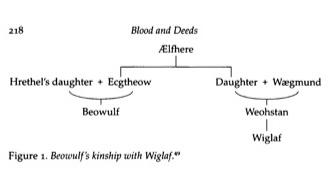
Ælfhere is mentioned as a kinsman of Wiglaf and Weohstan in line 2604a. We know nothing else about him. If Wild's genealogical table is correct, Wiglaf would be Beowulf's first cousin once removed. According to Lancaster, individuals with this blood relationship were not considered part of an individual's immediate kin group(48). These remote kin did not generally inherit either title or position. It was possible for there to be relationships of friendship between distant cousins, but these relationships were based on proximity and affinity, not blood(50). Wiglaf does not possess the requisite bloodline to inherit Beowulf's throne. When it comes to kingly inheritance, as far as Beowulf himself is concerned, deeds are not enough. Through deeds, a nephew can become like a son. Through deeds, a first cousin once removed can become like a nephew. But the transitive property does not apply to succession politics in the cultural world of Beowulf. A first cousin once removed, no matter how valorous, cannot overcome his weakness in blood through superior performance in deeds. He cannot advance as far as the position of son to successfully inherit. When Wiglaf is the only surviving family member, Hrethel's dynasty and the Geatish kingdom ends. Deeds are not enough.
GENDER AND INHERITANCE
Hybrid inheritance by both blood and deeds is essential in the cultural world of Beowulf, but the relative proportions of blood or deeds necessary to inherit is contested within Beowulf's culture ; different institutions and different social positions benefit from different ratios of blood and deeds. Although every individual can be seen as having some particular blend of blood and deeds from which he or she might most effectively benefit, we can also note that various groups within the culture will have broadly similar desiderata as to the most beneficial proportion of blood to deeds. The most important of these major divisions of inheritance interests in Beowulf is between men and women. A character's gender as constructed within the poem's system of gender ideology determines to a great extent the types of inheritances he or she may influence or participate in. As is most clearly demonstrated by Wealhtheow's reactions to Hrothgar's attempted adoption of Beowulf, (which has been called "astonishing" and "unsettling")(51), women in Beowulf have a much greater stake in inheritance by blood than they do in inheritance by deeds. After the queen counsels Hrothgar to leave the kingdom to his kinsmen, she proposes a protector for the kingdom if Hrothgar has the misfortune of dying before his oldest son can take the throne :
Ic minne can
glædne HroÞulf, Þæt he Þa geogoðe wile
arum healdan, gyf Þu ær Þonne he,
wine Scildinga, worold oflætest ;
wene ic Þæt he mid gode gyldan wille
uncran eafteran, gif he Þæt eal gemon,
hwæt wit to willan ond to worðmyndum
umborwesendum ær arna gefremedon.
Hweaf Þa bi bence, Þære hyre byre wæron,
Hreðric ond Hroðmund, ond hæleÞa bearn,
Giogoð ætgædere ; Þær se goda sæt,
Beowulf Geata be Þæm gebroðrum twæm. (1180b-1190)
["I know that my kind Hrothulf will rule in kindness the younger troop, if you, friend of the Scyldings, relinquish the world before him. I expect that he wishes to pay with goodness our heirs, if he remembers all the honors that we two gave him for his desires and glory when he was a child." Then she turned back to the bench where their sons were, Hrethric and Hrothmund, and the children of the warriors, the youth all together. There the brave one, Beowulf of the Geats, sat by the two brothers.]
Wealhtheow's apparent desire to put forth Hrothulf as an alternate heir or protector has provoked much controversy. Most historical critics of Beowulf have linked Hrothulf with the Scandinavian figure Roluo described by Saxo Grammaticus. Chambers sums up the argument thus: "Hrethric is ... almost certainly an actual historic prince who was thrust from the throne by Hrothulf",who was the nephew, rather than the son, of Hrothgar(52). Klaeber suggests that lines 1018, 1164, 1178, and 1228 all point to treachery by Hrothulf, and that it is "very likely" that Hrothulf usurped the throne(53). If this is the case, Hrothulf, unlike Beowulf, jumped his place in the line of succession and took the throne after the death of his uncle. Thus, with the benefit of literary and historical hindsight (which, presumably, the poet possessed) Wealhtheow's insistence upon him as protector for her sons seems at the least ill fated, if not foolish(54). Sisam, however, has pointed out the difficulties in this interpretation, coming to the conclusion that too much has been read into the possible conflict between Hrothgar and Hrothulf and that the line in question means "the good pair of kinsmen were still together (when Beowulf visited Heorot)(55). This analysis suggests that Wealhtheow's insistence upon Hrothulf as a proper heir for Hrothgar is neither "ironical" nor "pathetic(56).
It is still surprising, however. But it can be better explained by recognizing the position of women within the blood and deeds inheritance system(57) and arguing that Wealhtheow's gender interests in the system of inheritance by blood overshadow any desire to protect the rights of her nephew by marriage. It is hardly problematic to guess that Wealhtheow's first loyalty was probably to her sons. They are, as best we can tell, by far her closest kin in Heorot, and the mother-son bond does not seem to have been absent from Anglo-Saxon culture(58). Wealhtheow, we may safely speculate, would support Hrethric and Hrothmund for the throne if there were any chance of them succeeding to it and surviving, if they were legitimate in terms of deeds(59). But if the two boys are too young to succeed when Hrothgar dies, Wealhtheow, since she apparently could not take the throne herself, like Hygd, would have to support someone to take Hrothgar's place. Her apparent choice of Hrothulf over Beowulf suggests that the system of inheritance by blood is more important to her than a system of inheritance by deeds.
At the time of Wealhtheow's speech, Beowulf has proven himself by deeds. He has defeated Grendel, a feat previously beyond the powers of all of the Danes, including Hrothulf. However, while Wealhtheow is pleased to welcome Beowulf to Heorot, she clearly does not want him to become an heir to Hrothgar, demonstrating her "loyalty to Hrothulf that supersedes the queen's profound indebtedness to Beowulf"(60). But Beowulf has only earned Wealhtheow's loyalty by deeds ; Hrothulf is linked by blood, albeit indirectly. Although Hrothulf is not directly a blood relation of Wealhtheow, he is a blood relation (first cousin) to her sons(61). Wealhtheow is thus supporting the law of inheritance by blood. Although this inheritance is indeed blended (in that nephews and other kin, otherwise worthy by deeds, can inherit), Hrothgar's attempted adoption of Beowulf has gone beyond the system's limits. Wealhtheow insists de minimis on a hybrid inheritance of blood and deeds.
Wealhtheow works to reestablish these limits because a system of inheritance with a substantial blood component is the only system in which a female character is individually significant in the cultural world of Beowulf. She attempts to preserve the system by supporting Hrothulf not in a short-sighted attempt to hold on to her own political power in the Danish nation (she does not, after all, say that she expects Hrothulf to be kind to her, only to her sons) but as a defense of the cultural structures within which and by which her identity is constituted and her autonomy preserved. Wealhtheow is able to influence the behavior of men in Heorot. For example, she gives the great necklace to Beowulf and attempts to change Hrothgar's mind through public statements(62). She can exercise this power because she possesses a certain social position - a result of her function as a mother and spouse - in the system of inheritance by blood. Although Wealhtheow's very name (which can be translated as "foreign captive")(63) suggests exchange or seizure, unlike Hildeburh or Freawaru she does not appear to weld together two disparate families(64). Her peace-weaving is directed at violence in general rather than violence between any two warring family groups, and it is accomplished through her use of language rather than the physical exchange of her body(65). But this social identity is predicated upon Wealhtheow's pairing with Hrothgar and her participation in the king's dynasty. She is called "cwen Hroðgares" (v. 613a) (Hrothgar's queen), and "ides Sycldinga" (1168b) (lady of the Scyldings). When she speaks of her desire to have Hrothulf protect her sons she uses dual case pronouns, "uncran" (1185a) (of our two) and "wit" (1186a) (we two), binding herself and Hrothgar together as one and, more importantly, emphasizing that Hrethric and Hrothmund are the product of them both. Wealhtheow has produced heirs of Hrothgar's body, and without her there would be no inheritance by blood. The conditions for successful peace-weaving require the creation of heirs, as is seen both from Wealhtheow's successful performance of this role and the failures of Hildeburh and Hrothgar's daughter Freawaru : before the queen can speak the language of weaving, she must produce sons for the king.
The queen's interest, therefore, lies in the maintenance of the system from which she derives her personal value, power, and identity. A system of inheritance purely by deeds threatens Wealhtheow's identity not only because it eliminates the necessity for her specific and personal contribution to the Danish dynasty, but also because the bonds that would be created between Beowulf and Hrothgar are not mediated through a woman. Similarly, a system of inheritance solely by deeds would reduce the power of the queen in the royal court. Women's reproductive capabilities would remain necessary for the warrior band even if the system of blood inheritance were not hybridized with inheritance by deeds. But in such a system no specific woman would be necessary(66). If a king may merely choose his successor from among a pool of heroes validated only by their deeds, he need not concern himself with the blood origin of each man. Blood lineage becomes unimportant, and as fares blood lineage, so fare women in the cultural world of Beowulf.
In her efforts to prevent the inclusion of Beowulf in the line of succession, Wealhtheow is in fact aligned with the hero himself. Using her political and social skills, she tries to convince Hrothgar to rescind his offer of synthetic kinship. Beowulf also must use considerable political dexterity in order to avoid offending Hrothgar while simultaneously refusing the offer of adoption and thus maintaining his loyalty to his own blood-kin, Hygelac and the Geats(67). Hill's analysis of Beowulf as the juristic warrior, the ethically conscious figure who is always just and whose actions are always rightful, explains why Beowulf supports the already-existing inheritance system that requires both deeds and blood(68). James Earl identifies Beowulf as an "ego-ideal," a representation of what the audience of the poem found to be lawful, valorous, and excellent, but unattainable(69). The system of inheritance that Beowulf supports is therefore valued by the culture that produced Beowulf, and Wealhtheow's support for this system suggests that she is fulfilling her role in the culture in the same ideal fashion as Beowulf. For all participants in the warrior band, hybridized inheritance is the way things ought to be. The identities of both men and women are jeopardized if the rules of inheritance are changed. When Hrothgar grasps at the straw of inheritance through deeds only, he obviates the necessity to produce strong sons and calls into question the two-level so important to the culture. The strong reactions of both Wealhtheow and Beowulf to Hrothgar's attempt to escape the constraints of hybrid inheritances illustrates that these constraints are in some way essential to the society imagined by the Beowulf poet. The constraints of heroic civilization are integral to heroic identity.
THE TRAGEDY OF THE INHERITANCE SYSTEM
But herein lies a central paradox of the cultural world of Beowulf and a contradiction from which much of the tragedy of the poem arises. Inheritance with too strong an emphasis on blood cannot provide long-term security. A single sterile father, or one who through sheer chance does not produce sons (and whose sisters, if they exist, do not produce nephews), or one who reproduces too late in life, or whose son is killed, can bring a line to an end. Blood-based inheritance (even if the inheritance is not entirely blood-based) creates a noble, heroic society by controlling within-group violence. But the requirement that inheritance have some blood component leads inexorably to extinction(70). It is only a matter of time-although perhaps significant quantities of time when the blood requirement is relatively weak-before the thread is broken(71).
The great limitation of heroic civilization is that heroes and their lineages, children, great halls, and treasures will all pass from the earth. To reconstruct inheritance solely in the form of deeds, as Hrothgar's and Beowulf's failed attempts show, is impossible in the cultural world of Beowulf. The necessity of inheritance by both blood and deeds is an inextricable part of the absolute juristic character of the hero who serves as the ego-ideal throughout the poem. Inheritance in Beowulf cannot be either / or ; it must be both / and. However, in insisting upon both / and, the culture of the poem ensures its own eventual destruction(72). Even before the dragon works Beowulf's death and the end of his people, the poet has depicted the ultimate failure of inheritance :
Ealle hie deað fornam
ærran mælum, ond se an ða gen
leoda duguðe, se ðær lengest hwearf,
weard winegeomor, wende ðæs ylcan,
Þæt he lytel fæc longgestreona
brucan moste. ( v. 2236b-2241a)
[Death took them all at previous times, and now the one who remained from the warrior-troop of the people, who longest remained, the guard mourning for friends, expected the same thing-that he might enjoy only for a little time the ancient riches.]
The last survivor of the ancient race, who consigns the treasures of his people to the barrow where the dragon will find them, laments for the failure of noble, aristocratic institutions to reproduce themselves.
The sword and cup will not be lifted ; the helmet and corslet will rust away unpolished ; the harp will be silent; the hawk will not fly through the hall ; the horse will not ride through the settlement (v. 2252b-2265a). This is all a synecdoche for the tragedy at the heart of Beowulf. The poet's view is tragic not because Beowulf could have done anything differently to have saved his people (if not the dragon, then old age or some other foe would have ended his reign). And the tragedy is not only that he died without an heir. Rather, the tragedy of the cultural world of Beowulf is that it inevitably will end through the failure of inheritance. No system can be eternal. Blood-only replication leads to extinction. Deeds-only replication leads to uncontrollable violence. Hybrid inheritance is better, but in the end it fails also. There is no escape from the social system, because the system defines individual identity. And yet the constitution of the system leads inexorably to its own destruction. The silent barrow evinces the failure of life and lineage that haunts the poem, the poet, and the culture(73).